
One of the best definitions of leadership I’ve read comes from J. Oswald Sanders’ book Spiritual Leadership: “Leadership is influence.”
For spiritual leaders, that influence must never be taken lightly. It is a gift from God and a stewardship for Him. Whether our leadership is exercised in the home, church, workplace, or community, our choices influence those who watch and follow us.
Christian liberty is another gift God has entrusted to believers—the freedom under grace to follow our conscience in matters Scripture does not explicitly spell out. This liberty is so significant that when the apostle Paul was asked about eating meat that had been offered to idols, he did not simply issue a rule. Instead, he set forth the principle of Christian liberty.
But meat commendeth us not to God: for neither, if we eat, are we the better; neither, if we eat not, are we the worse. (1 Corinthians 8:8)
Yet even as Paul affirmed this liberty, he placed boundaries around its exercise. He was willing to limit his liberty rather than cause another believer to stumble.
But take heed lest by any means this liberty of yours become a stumblingblock to them that are weak. … Wherefore, if meat make my brother to offend, I will eat no flesh while the world standeth, lest I make my brother to offend. (1 Corinthians 8:9, 13)
Here we see an important principle for spiritual leadership: mature leaders are willing to limit their liberty when exercising it could become a stumbling block to others.
I like to illustrate the responsibility of leaders with the following diagram:
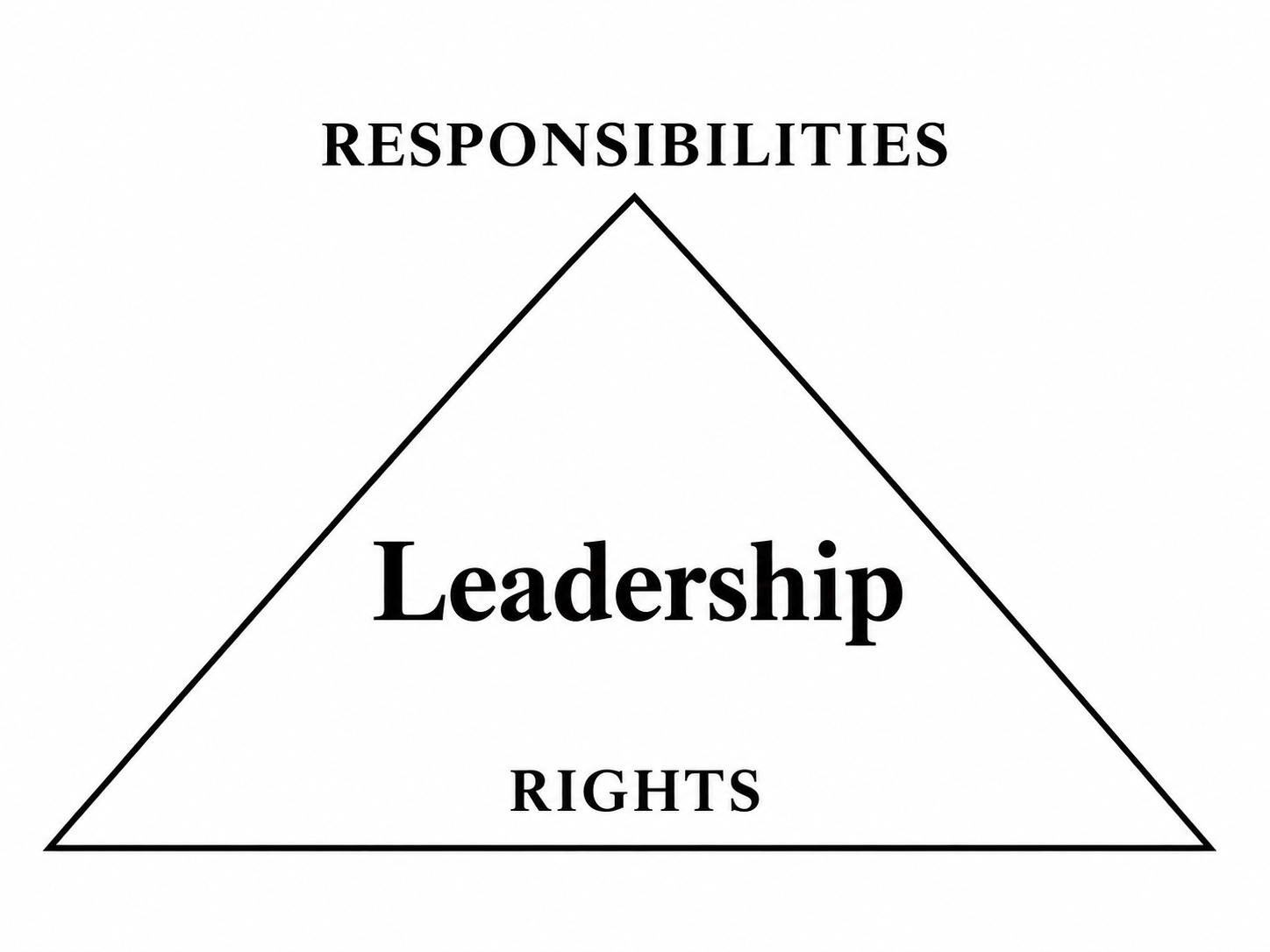
The higher you move in leadership (represented here by the sides of the triangle), the fewer rights you insist on. Instead, you move toward responsibilities. In a sentence: leaders limit liberty.
Paul develops this principle in Romans 14:
So then every one of us shall give account of himself to God. Let us not therefore judge one another any more: but judge this rather, that no man put a stumblingblock or an occasion to fall in his brother’s way. … Let not then your good be evil spoken of: … Let us therefore follow after the things which make for peace, and things wherewith one may edify another. (Romans 14:12–13, 16, 19)
What does a willingness to limit liberty look like in practice? Romans 14 gives us three guiding principles:
1. Be Discerning
Every Christian should live with the awareness that one day we will stand before Christ and give account for our choices.
So then every one of us shall give account of himself to God. (Romans 14:12
Where Scripture gives a clear command, our responsibility is simple: obedience. But in areas of Christian liberty, we need spiritual discernment. First Corinthians 6:12 reminds us, “All things are lawful unto me, but all things are not expedient.” Something may be permissible without being profitable.
For spiritual leaders, this responsibility carries additional weight. Not only will we give account for ourselves, but Scripture reminds us that leaders, particularly pastors, “watch for your souls, as they that must give account” (Hebrews 13:17).
Christian liberty should be exercised with a clear conscience before Christ, believing our choices are wise, expedient, and pleasing to Him.
2. Live Responsibly
Leadership also requires us to recognize that our choices do not affect us alone. Those who follow us often take their cues from what they see in us.
Let us not therefore judge one another any more: but judge this rather, that no man put a stumblingblock or an occasion to fall in his brother’s way. (Romans 14:13)
The things leaders do in moderation are often done in excess by the next generation. That reality should make us especially careful in how we exercise Christian liberty.
There are times when a leader should limit a liberty—not because Scripture directly forbids it, but because exercising it could confuse a younger Christian, weaken someone who is struggling, undermine the convictions or practices of the ministry he serves, or diminish his effectiveness as a leader.
So a mature leader moves beyond, “Do I have the liberty to do this?” to additional questions: “Could this become a stumbling block to others?” “What will this communicate to those who follow me?” “Could my liberty damage the testimony of Christ?”
That is not bondage. It is responsible leadership.
3. Be Considerate
Our choices affect how others view our testimony for Christ. Thus, Paul gives an important word of caution:
Let not then your good be evil spoken of…. Let us therefore follow after the things which make for peace, and things wherewith one may edify another. (Romans 14:16, 19)
Something may be permissible before God yet easily misunderstood by the people we are trying to reach or lead. A considerate Christian values his testimony more than his liberty.
As spiritual leaders, we never want a personal choice to become an unnecessary distraction from the message we preach or the ministry God has entrusted to us.
So before exercising a liberty, we should consider not only whether we can do it, but whether doing so will strengthen or weaken our testimony with those we are seeking to influence. And beyond protecting our testimony, we should ask whether our choices will edify others—whether they will help build their faith and encourage their spiritual growth.
The goal of Christian liberty is not to discover how close we can live to the edge. It is to use every area of our lives for the glory of God and the good of others.
Love Voluntarily Limits Liberty
At its heart, this principle is not about restriction but about love.
Love does not ask only what it is free to do. Love considers the effect of its choices on others. It values another believer’s growth, the testimony of Christ, and the strength of the ministry more than the exercise of a personal right.
That is why love voluntarily limits liberty. Galatians 5:13 gives this instruction: “For, brethren, ye have been called unto liberty; only use not liberty for an occasion to the flesh, but by love serve one another.”
For a spiritual leader, the highest use of Christian liberty is to exercise it in a way that helps others follow Christ.