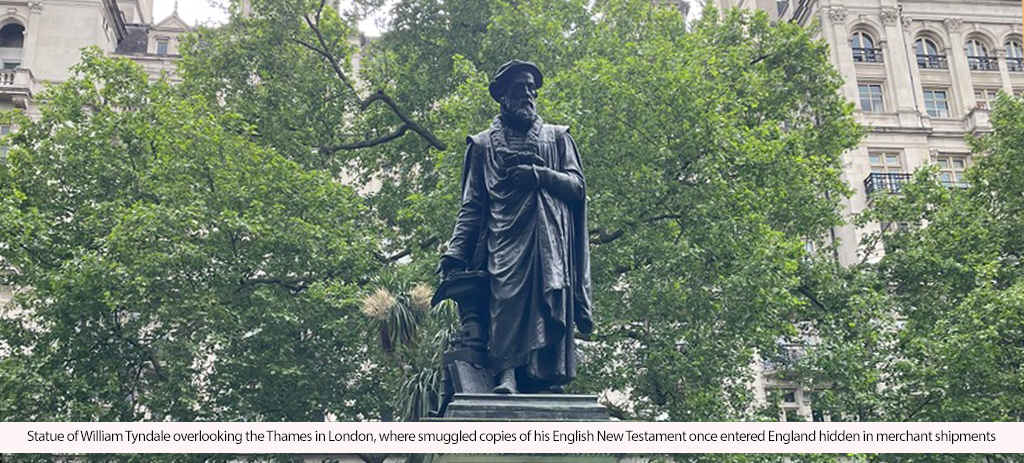
Five hundred years ago this spring, printed copies of the first English New Testament translated from Greek reached English soil. Hidden in sacks of flour, bales of cloth, and barrels of oil, they passed quietly up the River Thames. Carried ashore by faithful merchants and Lollard believers, they soon flooded London.
It was 1526, and England would never be the same. What arrived on those ships was more than ink on paper. It was the powerful Word of God.
The story traces back to one man—courageous, brilliant, and unshakably convinced that the Bible should speak in the language of the people.
William Tyndale was born in Gloucestershire around 1494. Educated at Oxford and Cambridge, Tyndale mastered Greek and became fluent in eight languages—so fluent that John Foxe wrote, “Whichever he spake, you would suppose it his native language.”
Through reading the Greek New Testament, Tyndale discovered and believed the simple gospel of salvation by grace through faith in Christ. As he studied Scripture, he became convinced that the spiritual darkness of England could only be lifted by giving people the Bible in their own tongue.
In sixteenth-century England, ordinary people had almost no access to Scripture. The Catholic Church held copies of the Bible in Latin, but translating it into English was forbidden by law.
When a clergyman argued that it would be better to go without God’s Word than to oppose the Pope, Tyndale famously replied, “I defy the Pope and all his laws. If God spare my life, ere many years, I will cause a boy that driveth the plow to know more of the Scripture than thou dost.”
Refused permission to translate, Tyndale fled England in 1524 and began his work in exile. Two years later, his completed New Testament was printed in Worms, Germany, and secretly shipped to England.
Church authorities responded with fury, burning copies of the book and hunting its translator. But God’s Word is not easily silenced. As Isaiah 55:11 promises, “It shall not return unto me void.” The Bible spread quickly, fueling revival and reformation across England.
Tyndale was eventually captured through betrayal, imprisoned near Brussels, and executed in 1536—only ten years after his work first reached England. During that decade, he persevered in translation. He revised his New Testament twice, translated the Pentateuch and other portions of the Old Testament, and wrote significant works defending the authority of Scripture and salvation by grace. Even under threat of death, he would not cease his labor.
As Tyndale stood at the stake, he prayed aloud, “Lord, open the King of England’s eyes.” This prayer was soon answered. Within a year, an English Bible was authorized for public reading, drawn largely from his work.
Five centuries later, the Word Tyndale gave his life to translate is still at work.
Tyndale invested—and ultimately gave—his life for one of the greatest needs of humanity: access to the living, powerful Word of God. He understood what many in his day did not—that Scripture is essential to the Christian life and the local church. It is the very instrument through which God saves sinners, comforts sufferers, and equips His church.
Today, you and I have access to Scripture because of Tyndale’s sacrifice. But perhaps we forget just how powerful Scripture is. Hebrews 4:12 tells us, “For the word of God is quick, and powerful….” Indeed, God’s Word is powerful. And when it was unleashed across Europe, it changed the course of history.
The Word of God Is Powerful to Save
A sometimes overlooked fact is that the spread of the gospel during the Protestant Reformation (1517–1648) advanced alongside the translation of Scripture. Consider the timing. Erasmus published the first printed Greek New Testament in 1516. Soon after, these translations followed:
- 1522 – German New Testament
- 1525 – Zurich (Swiss) New Testament
- 1526 – English New Testament
- 1526 – Dutch New Testament (translated largely from German)
- 1535 – French Bible (New Testament from Greek, Old Testament from Hebrew)
As the Bible became accessible in German, English, French, and other languages, the gospel became accessible as well.
In almost every testimony of the men who became Anabaptist leaders or Reformers, we find the same story: a priest or scholar, steeped in the traditions of the state church, came into contact with Scripture—whether in Greek or in his native language—read it carefully, and discovered the simple truth of salvation by grace through faith in Christ. Having trusted Christ as Savior, he began to teach and preach the Word. For this he was persecuted. Yet the gospel itself, carried on the powerful words of Scripture, continued to spread.
As we share the gospel today, we should remember that the Holy Spirit works through His Word to convict hearts and reveal the need for a Savior.
“So then faith cometh by hearing, and hearing by the word of God” (Romans 10:17).
The Word of God Is Powerful to Comfort
Who can measure what it has meant for suffering believers across the millennia to hold Scripture in their hands and read its promises?
We can picture Tyndale himself—cold, hungry, and always knowing he was one step away from arrest and death—translating the Bible by candlelight. Imagine what it meant to him to steep his mind in the words of these passages as he translated them:
“For I reckon that the sufferings of this present time are not worthy to be compared with the glory which shall be revealed in us” (Romans 8:18).
“That the trial of your faith, being much more precious than of gold that perisheth, though it be tried with fire, might be found unto praise and honour and glory at the appearing of Jesus Christ” (1 Peter 1:7).
The same Word that comforted persecuted saints then still steadies grieving, anxious, heavy hearts today.
The Word of God Is Powerful to Equip
When Scripture spreads, churches grow strong.
From the Waldensians to the Lollards to the Anabaptists, effective ministry followed the availability of God’s Word. The preaching of Scripture trained evangelists, formed disciples, and established churches.
Without the Word of God, we cannot equip believers or disciple the next generation.
“All scripture is given by inspiration of God…that the man of God may be perfect, thoroughly furnished unto all good works” (2 Timothy 3:16–17).
The Power of the Word Endures
Today, five hundred years later, we celebrate the courageous faith and dedicated labor of William Tyndale. But even more, we praise God for His amazing, powerful, and preserved Word that still saves, still comforts, and still equips His church.
“Thy word is very pure: therefore thy servant loveth it….Seven times a day do I praise thee because of thy righteous judgments” (Psalm 119:140, 164).
May we give ourselves to read it, study it, preach it, and share it—especially with those around the world who have not yet heard the gospel or who do not have Scripture in their language.
The same Word that changed Europe five centuries ago is still changing hearts today.
As part of this year’s Spiritual Leadership Conference September 27–30 and in partnership with Dave Smith and the Museum of the Book in London, we are honored to present a special historic Scripture display with dozens of incredible rare prints of Scripture. Included in this collection is an original 1526 Tyndale New Testament. For more information on this exhibit as well as the conference, visit slconference.com.